
The first
photograph that caught my attention was a piece by Aaron Siskind. I walked up
to the photograph unsure of what it was really capturing. After a long look, I
realized that it was a photograph of a wall. In the photograph, you can see
paint rolling down the walls when it was still wet, and there are a few patches
here and there where the paint is ripped off. I thought this piece was
interesting because it looked really realistic up close. It looks like I can
just reach my hands out and feel the texture of the wall, the bumps and the dripping
paint. Another thing that I find unique about this piece is that Siskind captures
and brings attention to something that people usually just walk past in their
everyday lives. We do not take the time to notice these small things, but I
like the idea that even something so commonly forgotten can be art. In addition,
these imperfections on the wall are usually hidden or covered up, so the
contrast of seeing these photographs framed and hung on the museum wall gives
me a new perspective. It’s not something that I would expect to be in a museum,
but I think that is the reason why it caught my attention in the first place. I
think Siskind was successful in capturing the art in old walls.

The
second piece that I really liked was the series of photographs by William
Wegman. Wegman used his dog as the main point of attention in his photographs.
One particular photograph that I found aesthetically pleasing was titled “Of
the Lake”. The photograph captures Wegman’s dog sitting in the water with the
sun shining behind it. Because this was a black and white photograph and
probably because of the light when the photo was taken, the dog is almost just
a silhouette in the picture. You acknowledge that the dog is present, but more attention
is brought to the background where you can see the sparkles in the water as the
sun hits it. The lighting and coloring of this photo sets the mood, leaving the
viewer feeling relaxed and at ease.
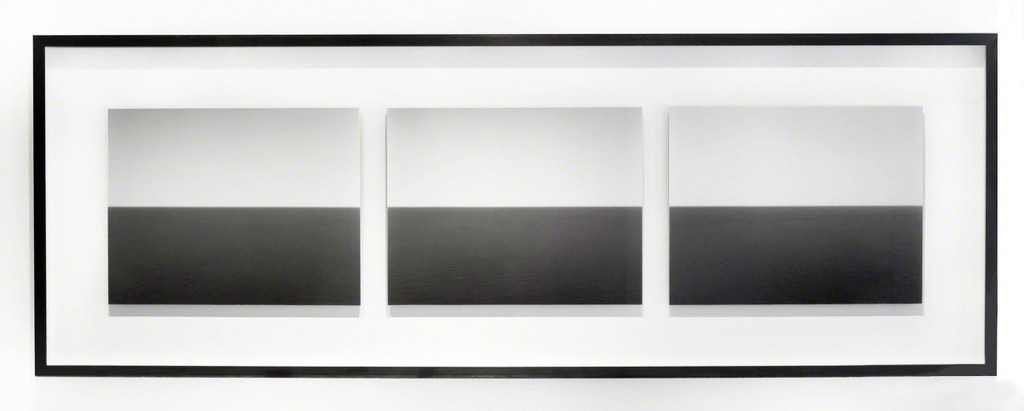
I
found Hiroshi Sugimoto’s “Adriatic Sea, Gargano I” interesting as well.
Sugimoto’s piece features three photographs that look almost the same. This was
the main reason why I was attracted to this piece. I was not very sure what the
photographer was capturing and why there were three of the same photos. After
reading the description, I realized that they were pictures of the sea. As I
took a step back to look at the three photos side by side, it appears as if I
was looking through the windows on a boat. I liked the simplicity of the
photographs. Sugimoto could have captured the sea when a boat was passing by or
when there was more scenery, but he chose to just capture the sea in the
foreground and nothing in the background. This makes the piece unique and
places the focuses on the distinct line that separates the sea and the sky.

No comments:
Post a Comment