Saturday, May 20, 2017

Blog Post 4: Trip to the MOMA


The first photograph that caught my attention was a piece by Aaron Siskind. I walked up to the photograph unsure of what it was really capturing. After a long look, I realized that it was a photograph of a wall. In the photograph, you can see paint rolling down the walls when it was still wet, and there are a few patches here and there where the paint is ripped off. I thought this piece was interesting because it looked really realistic up close. It looks like I can just reach my hands out and feel the texture of the wall, the bumps and the dripping paint. Another thing that I find unique about this piece is that Siskind captures and brings attention to something that people usually just walk past in their everyday lives. We do not take the time to notice these small things, but I like the idea that even something so commonly forgotten can be art. In addition, these imperfections on the wall are usually hidden or covered up, so the contrast of seeing these photographs framed and hung on the museum wall gives me a new perspective. It’s not something that I would expect to be in a museum, but I think that is the reason why it caught my attention in the first place. I think Siskind was successful in capturing the art in old walls.

            The second piece that I really liked was the series of photographs by William Wegman. Wegman used his dog as the main point of attention in his photographs. One particular photograph that I found aesthetically pleasing was titled “Of the Lake”. The photograph captures Wegman’s dog sitting in the water with the sun shining behind it. Because this was a black and white photograph and probably because of the light when the photo was taken, the dog is almost just a silhouette in the picture. You acknowledge that the dog is present, but more attention is brought to the background where you can see the sparkles in the water as the sun hits it. The lighting and coloring of this photo sets the mood, leaving the viewer feeling relaxed and at ease.
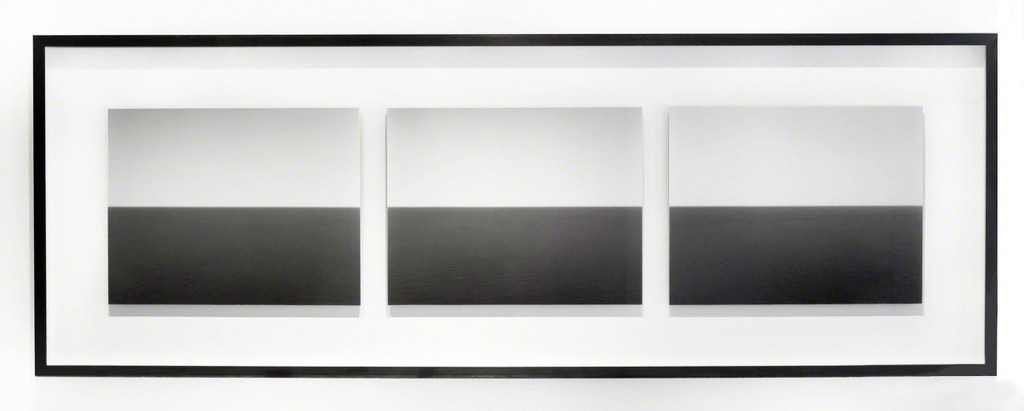

            I found Hiroshi Sugimoto’s “Adriatic Sea, Gargano I” interesting as well. Sugimoto’s piece features three photographs that look almost the same. This was the main reason why I was attracted to this piece. I was not very sure what the photographer was capturing and why there were three of the same photos. After reading the description, I realized that they were pictures of the sea. As I took a step back to look at the three photos side by side, it appears as if I was looking through the windows on a boat. I liked the simplicity of the photographs. Sugimoto could have captured the sea when a boat was passing by or when there was more scenery, but he chose to just capture the sea in the foreground and nothing in the background. This makes the piece unique and places the focuses on the distinct line that separates the sea and the sky. 

Saturday, May 13, 2017

Blog Post 3: Relationship Between Shots

For this assignment, I’ll be analyzing the ending scene from a short film on Youtube called “Agents of Secret Stuff” starting from 31:14 to 33:18. The short film centers around an undercover secret agent, Aden, whose missions is to protect a high school student, Taylor. Taylor convinces Aden that she is not in danger and, instead, teaches him how to become a normal high school student. To her surprise, the two encounter some trouble with the secret agency and Taylor misses her school’s homecoming dance that she has been planning for a while. The ending scene shows Taylor and Aden arriving to the dance after it is over. The music, camera angles, and editing of the ending scene contributed greatly to the romantic and comedic interaction between the two characters.

          The scene starts with a pan shot of the street lights outside the school where the homecoming dance is held. This sets the time and space, allowing the viewer to know that it is late and the dance is already over. There is a close shot of Taylor running up to the door handle and tugging on the doors to open. The camera then tilts up to Taylor’s disappointed face. The close up of these two shots sets the mood for urgency and disappointment. The mood changes to a romantic one when Aden asks Taylor for a dance and the music starts to play to set the mood. The music slowly becomes softer as Taylor begins to speak. While the two are dancing, the camera shots are close ups of their faces, which gives off a close, intimate and romantic feeling. The shots switch between Taylor and Aden as they are speaking to each other, but remain close up to their faces to maintain the intimate feel. When the two are interrupted by a sound in the bush, the music stops, and the romantic mood changes to an anxious mood. The shot is a medium close up of Aden and Taylor looking into the distance. The medium close up shot allows the viewer to see the danger in their eyes and facial expressions. The camera then switches to a long shot when Taylor says she’ll go left and Aden will go right. The long shot shows the space that the characters will eventually run off to. The scene then switches back to a medium close up and the music resumes as the two characters kiss before parting. The medium close up shot and music resumes the romantic mood. The scene ends with a long shot of Aden running off to the right and Taylor running off to the left. Each camera shot was not too long, and switches between Aden and Taylor to keep the viewers engaged and interested. I also like the effective use of music to set the mood. Overall, I think this was a successful scene and a great way to end the short film.

Monday, April 17, 2017

Audio Interview


Music:
"Acoustic Breeze" from http://www.bensound.com
"Memories" from http://www.bensound.com
"Tenderness" from http://www.bensound.com
Sound Effects:
"01592 dialing phone number" by Robinhood76 from freesound.org
"003 - Invasion Alarm" by felipejordani from freesound.org
"Ambience Birds in backyard" by lizanejordaan from freesound.org
"Big Crash" by PatrickLieberkind from freesound.org
"children playing" by goldkelchen from freesound.org

Tuesday, April 4, 2017

What I Hear

For my sound walk, I decided to stop by a nearby park in my neighborhood in Brooklyn. This park brings back so many memories as it was like a second home to me while growing up. As a child, my parents would always bring me to play on the swing sets and slides. In middle school and high school, the park was a popular hang-out destination for me and my friends while we sat on the benches and talked about our day. When I grew older I stopped visiting the park, but I would pass by the park on my way to work every week.
As I walk around the perimeter of the park where the fences separate the busy streets from the inside of the park, I can hear the cars and buses drive down the block with a few honks here and there. As I enter the park and walk towards the center to the garden, the atmosphere and sounds change instantly from the chaotic sounds of the street to the serene sounds of the birds chirping and crackling sounds of the branches as the wind blows against the trees. I walked away from the garden and towards the swing sets and play station. It was a warm, sunny spring afternoon. The keynotes or background sounds include older men laughing and chuckling with each other as they play cards on the park tables. I hear squeaking noises as children swing up and down again. I hear the sounds of scooters and bicycles rolling against the cement floors. A child riding a bike seems to enjoy the sound of the bell on his bicycle. Ding, ding, ding as he zooms by. Children are laughing and screaming each others’ names as they run after one another. Parents are conversing with each other on the benches and calling their children's names when they wander too far off. I hear a familiar tune or sound signal coming from afar and I instantly know that it is the sound of the ice-cream truck calling for children to run towards it. I am reminded of my younger self dragging my parents by the hand to the ice-cream truck. Although I have stopped going to this park since entering college, the sounds are still all so familiar to me and reminds me of the memories I’ve had here while growing up.

Monday, February 6, 2017

ARTIST STATEMENT

Art has always been my comfort zone. It allows me to express my feelings and ideas visually. Growing up, I’ve always enjoyed art and crafts and any type of hands-on designing. I loved cutting out pictures and letters from magazines, then gluing them together with photographs to make photo collages. I spent a lot of time making photo slideshows on my computer, with a new picture popping in or sliding out to the beat of the background music. I also enjoyed playing a game on my Nintendo DSi that allowed me to draw short stop motion animations. Unsurprisingly, some of my favorite classes in high school were drafting and woodworking. In drafting class, I learned to create 3D models on the computer using a program called AutoCAD. In woodworking class, I utilized the various tools to cut and shape pieces of wood to make coin banks and a jewelry box. I guess the thing that really draws me in to art is that there is no right or wrong, and artists are free to express their creativity.

Some of my biggest sources of inspiration come from Youtube. I am especially drawn to Youtube videos that are comedy-based because I think that comedy connects people; you have to be able to understand a joke in order to find it funny, and who wouldn’t like a good laugh. I find that sometimes the humor in a video is not solely what is being said, but the editing and video effects also play a big role. Therefore, I would like to focus more on video editing, and play around with different video effects to see how that can enhance the overall mood of the video. I hope that I would be able to teach, entertain, and inspire others with my work.